World Cup· Season 2027

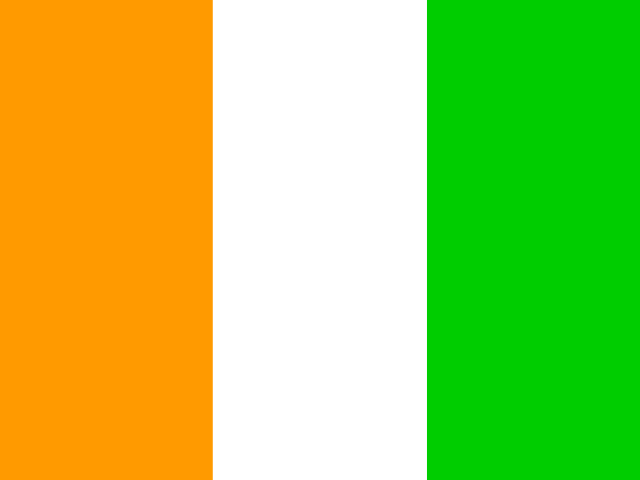
Ivory Coast beat Mali 83-77 in the FIBA World Cup African Qualifiers, knocking Mali from the unbeaten ranks in Group F at Dakar Arena.
Match Analysis
AI SummaryHow It Unfolded
Ivory Coast seized control early and built a double-digit lead in the first half, according to play-by-play data. Mali, who had won five straight in the qualifiers coming into this fixture, spent the second half clawing back into the contest but never fully closed the gap.
The Ivorians managed the game expertly down the stretch, keeping Mali at arm's length despite the Eagles' persistent pressure. Mali's last unbeaten record in the group evaporated as Ivory Coast held on through a tense final quarter.
The Turning Point
Ivory Coast's first-half surge proved decisive. Leading by as many as ten points at their peak, the Elephants established a buffer that Mali could never fully erase. Each time the Eagles cut the deficit, Ivory Coast found an answer — a timely three-pointer or a stop on the defensive end — to keep the lead intact.
Key Performers
Assemian Moulare was the difference-maker for Ivory Coast. The guard entered Window 4 averaging 16.0 points and 6.3 assists per game across the qualifiers, and he delivered again with a composed all-court display that kept the Ivorian offence flowing in the half-court.
Amadou Sidibe patrolled the paint effectively, pulling down a team-high 8.3 rebounds per game for the tournament. His work on the glass limited Mali's second-chance opportunities and gave Ivory Coast extra possessions at key moments.
Siriman Kanoute carried Mali's hopes once more. The star guard came into the game averaging 19.2 points, 9.2 assists and 5.7 rebounds per game in the qualifiers — the best efficiency rating (22.0) in the competition. He posted another strong all-round performance, but the supporting cast could not quite match Ivory Coast's collective firepower.
Oumar Ballo added muscle in the paint for Mali, contributing his usual double-double threat (13.5 PPG, 9.2 RPG in the qualifiers), but Ivory Coast's defensive schemes limited his impact relative to previous outings.
By the Numbers — Interpreted
The FIBA team comparison for the qualifiers shows how evenly matched these sides were on paper heading in. Ivory Coast entered averaging 94.8 points per game to Mali's 80.7, suggesting a faster tempo. The Elephants also shot better from three-point range (33.2% to 29.1%) and the free-throw line (70.2% to 65.2%), while Mali held advantages in rebounding (43.8 to 46.3 per game) and blocks.
The six-point margin reflects a game that was tight where it mattered — the final five minutes — but where Ivory Coast's superior perimeter shooting and composure from the stripe made the difference.
What It Means
Group F is now a three-way tussle at the top. Senegal (6-1) lead on points difference, level on wins with Ivory Coast (6-1). Mali (5-2) drop to third alongside Angola (5-2). The top two sides in the group plus the best third-placed team across Groups E and F will qualify for the 2027 FIBA World Cup in Qatar.
Mali face the Democratic Republic of the Congo on 29 August and then Senegal on 30 August in a pivotal double-header. Ivory Coast take on Egypt on 29 August before a potentially decisive clash with Angola on 30 August.
Verdict
This was the statement win Ivory Coast needed — beating a fellow group leader on the opening day of Window 4 changes the trajectory of their campaign. Mali, despite the loss, remain very much in the hunt with two more group games to play. The rematch potential between these two in the qualification race is far from settled.
Rivalry since 2009
Mali vs Ivory Coast Head to Head Results· 8
Mali and Ivory Coast have met 8 times — Mali won 4, Ivory Coast won 4, with 0 draws. Their rivalry dates back to 2009. A combined 1148 goals have been scored across these fixtures, averaging 143.50 per match (574 for the home side, 574 for the visitors). Both teams scored in 8 matches (100%). Over 2.5 goals landed in 8 games (100%), making it a fixture that tends to produce goals. The highest-scoring encounter finished 96–102 in 2025.
Statistics are for informational purposes only. Past performance does not guarantee future results.
API data: 28 Aug 2026